


Hunt solar flares
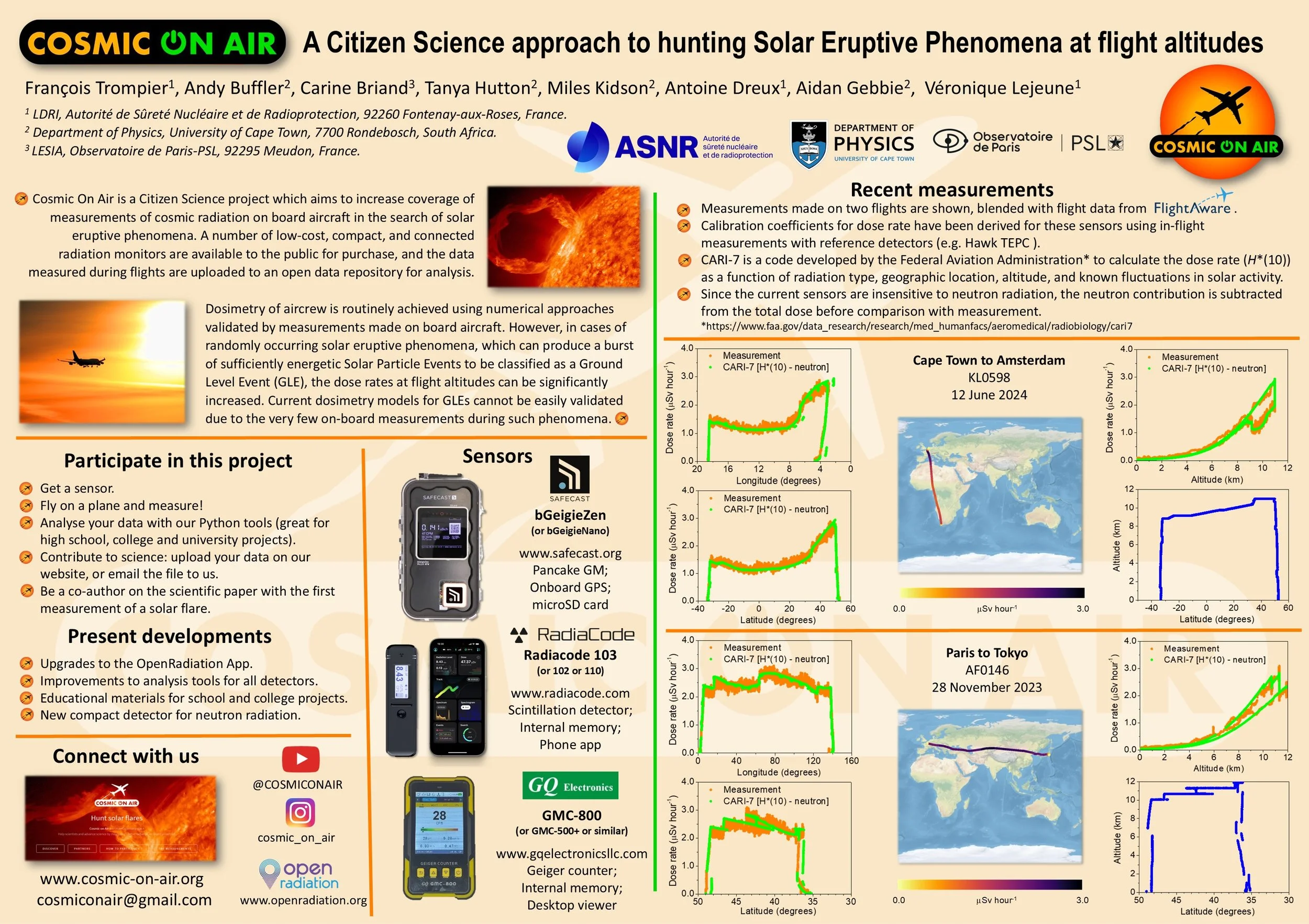
Cosmic On Air is a citizen science project
Measure cosmic radiation when you fly and contribute to real research
The Cosmic On Air project
The Cosmic On Air citizen science project aims to collect radiation measurements on board commercial flights. These measurements are made available to the scientific community and are used to study how radiation levels vary with altitude, latitude, and solar activity.
In rare cases, solar eruptions can significantly increase radiation levels at flight altitude. These events are unpredictable and difficult to measure, meaning that high-quality in-flight data are limited.
By contributing your data, you help improve our understanding of radiation in the atmosphere and support research into these rare but important phenomena.
Read more about cosmic radiation at flight altitude here.
How to participate
Measure radiation during a flight
Upload your data to the Cosmic On Air database
Explore and analyse your measurements using the toolkit
If you are interested in sponsoring sensors for schools in developing countries, please contact us to discuss how to do this.
Project highlights
The Cosmic On Air project was presented at the International Astronomical Union (IAU) General Assemblyin Cape Town (July 2024), highlighting its role in citizen science measurements of radiation in aviation. The project brings together researchers from the Autorité de sûreté nucléaire et de radioprotection (ASNR), Observatoire de Paris and University of Cape Town.
Cosmic On Air was featured by Nature Africa. Read the article here.

Project partners

The Autorité de sûreté nucléaire et de radioprotection (ASNR) is the independent regulatory authority for nuclear safety and radiation protection in France. ASNR regulates civil nuclear activities, conducts research, and oversees radiation protection, aiming to streamline nuclear safety governance while supporting the revitalization of the French nuclear industry.

Founded in 1667, the Observatoire de Paris is the largest national research centre for astronomy in France, with 30 % of all French astronomers working in its five laboratories and its institute.

The Metrological and Applied Sciences University Research Unit (MeASURe) within the Department of Physics, University of Cape Town, South Africa, focuses on applications which require novel measurement techniques, particularly using neutron and gamma radiation.